
Many CPG brands now run retail media on several marketplaces at once. Amazon and Walmart may be easy to handle on their own, but once you add Instacart, Target, and Chewy to the mix, figuring out where your budget actually drove sales gets complicated fast.
That’s because marketplaces set different rules for which purchases an ad can receive credit for and how long after a click that credit can be claimed. Reported sales may also include purchases the brand would have won anyway through organic search, making a campaign look more productive than it really is.
This cross-retailer attribution problem gets harder to untangle with every marketplace a brand adds. Incremental fraction is a metric that provides brands with a more consistent way to assess how much additional business their advertising generates and a stronger basis for deciding where to spend next.
Why retail media attribution doesn't compare across Amazon, Walmart, and other marketplaces
Retail media teams have plenty of campaign performance data to work with. ROAS may look like a simple measure, but comparing it across marketplaces requires particular care because there’s little standardization around what counts as an ad-driven sale.
Take, for example, Amazon’s Sponsored Products, which credits a purchase to an ad click within 7 days for sellers and 14 days for vendors. Walmart Connect Sponsored Search, on the other hand, lets advertisers view attributed sales across three windows (3, 14, or 30 days after an ad interaction), with in-store sales shown separately.
This means a checkout that happens 10 days after an ad click could count toward Walmart’s report and fall outside Amazon’s. That makes comparing ROAS across marketplaces akin to comparing apples and oranges, given that different reporting rules (not necessarily better advertising) can contribute to higher returns.
What over-attribution costs CPG brands
Even with matching windows, ROAS still cannot tell brands whether a purchase would have happened without advertising.
Branded search is the most common example. A shopper who types a cereal brand’s name into Amazon has already expressed a preference. If its products also rank near the top of organic results, a sponsored listing may collect a click that would otherwise go to an unpaid one. The campaign gets credit for the sale, and ROAS looks great.
Brands may still need to defend those placements when competitors bid on their name. But a strong ROAS can encourage them to keep increasing spend without knowing how much additional business it brings. That leaves less budget for reaching shoppers who are still on the fence about what to buy.
How does incremental fraction help brands compare marketplaces?
Incremental fraction helps brands compare advertising performance across marketplaces by estimating the share of their revenue attributable to advertising. If a campaign has an incremental fraction of 40%, for example, that means an estimated four in 10 attributed sales wouldn't have happened without the ads.
Organic visibility helps explain the distinction. A product buried in search results may need advertising to get noticed, while a product already sitting at the top of the unpaid results may capture some of those purchases without the brand paying for another placement. Agentic retail platforms can use that context, alongside signals about shoppers’ buying intent and how closely the product matches their search, to estimate how much revenue ads actually add.
To make a spending decision, though, teams also need to account for cost. Multiplying reported ROAS by the incremental fraction gives them incremental ROAS (iROAS), the estimated additional revenue generated per advertising dollar.
Take a look at these two campaigns:
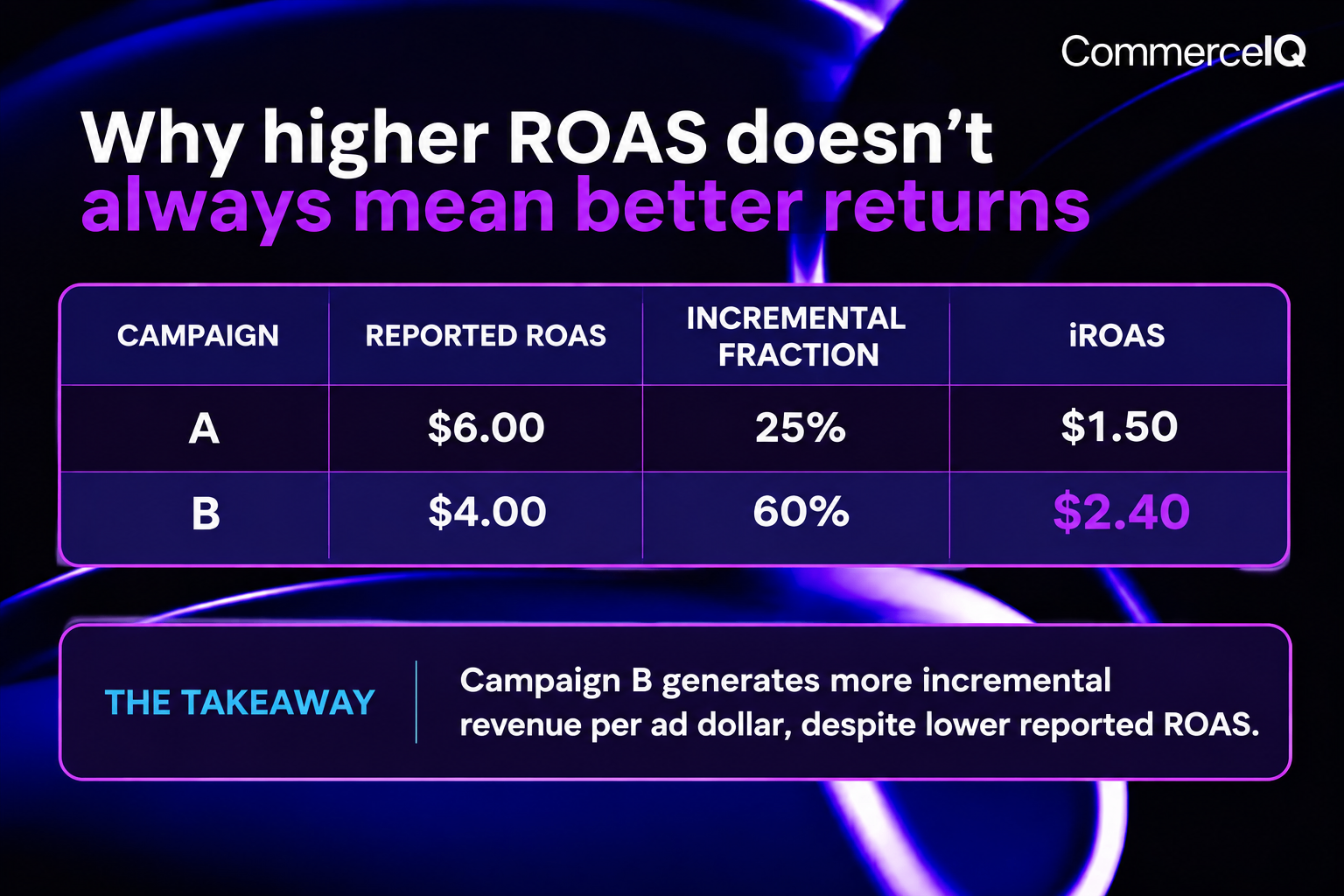
Campaign A looks better on the marketplace’s dashboard, but Campaign B generates more new revenue per dollar and deserves closer scrutiny in the next budget review.
This distinction becomes especially useful when the campaigns run on different marketplaces. Amazon and Walmart may have different rules for attributing sales, but iROAS helps brands look beyond each retailer's reported performance to estimate how much additional revenue their ads are generating. That gives teams a more consistent basis for deciding where to invest, rather than simply directing more budget toward whichever marketplace reports the highest ROAS.
Where incremental fraction is harder to apply
Incremental fraction is most reliable when every shopper searching a term sees about the same results. But last-mile marketplaces like Instacart and DoorDash don't work that way. Not only do shoppers log in to a specific store or ZIP code, but product availability and organic rank change with store location. This means that the same sparkling water might appear first at one store and well down the page at another nearby store, making it harder to determine a representative picture of organic visibility.
Amazon isn't entirely immune to this problem, either. Under its regional fulfillment model, a product that's readily available to shoppers in one part of the country may be unavailable in another, whether due to local inventory or fulfillment constraints.
That’s why incremental fraction shouldn’t be your standalone metric, especially when you’re making significant spending decisions. Marketing mix modeling (MMM) can help assess how investment contributes to sales across the broader media mix, while holdout tests evaluate what happens when advertising is reduced or withheld.
Relying on methods like these can help teams assess whether a promising campaign-level estimate warrants a larger budget change.
Put incrementality measurement to work
Once brands can compare the additional sales their ads generate across marketplaces, they can use those estimates to guide spending. But these estimates need updating as organic rankings change; a product that now ranks near the top of search results may need less paid support than it did last month.
For CPG brands, the next step is to make incrementality an ongoing part of how retail media budgets are managed, rather than treating it as another metric to review only after a campaign ends. That means regularly reassessing where advertising is adding sales, where organic visibility is doing more of the work, and whether budgets should move accordingly.
As brands spread their spending across more retailers, the ability to act on those changes will matter just as much as measuring them accurately in the first place.