
For years, brands bought awareness and performance through separate channels. Awareness budgets went to broadcast TV and other upper-funnel media, while marketplace ads handled the moments closest to the sale. That line has blurred as marketplaces have begun selling streaming and video inventory backed by purchase data that no broadcast network can match.
Amazon's ad revenue surpassed $68 billion in 2025, and more than $12 billion of last year's growth came from its full-funnel strategy, meaning more of brands' awareness budgets are now being spent on marketplaces.
But the more brands invest in these formats, the more they rely on the marketplace to tell them what that spend delivered. The same marketplace that sells them the ad space sets the attribution rules. Its attribution reports can show which campaigns a shopper saw before buying, but they aren't designed to answer the question that matters most for budget decisions: Would that sale have happened without the ad? Without that answer, attribution can be inflated or simply incorrect, and brands end up moving budget based on credit their ads didn't fully earn.
Brands that rely solely on marketplace-reported attribution are missing half the picture. They need to know which sales their awareness spend actually created so they can shift budget toward the audiences and channels generating incremental revenue, grow category share, and respond to competitors faster.
Marketplace attribution overstates what awareness ads deliver
Marketplaces record both impressions and purchases, so a team buying Prime Video ads across several audiences can see which segments are leading to orders and shift budget toward them while the campaign is still live.
But that speed is only as useful as the numbers behind it, and those numbers come from the company that sold the ads. Each marketplace decides how long after an impression a purchase still counts toward a campaign, and the longer that window, the more sales the ad gets credit for. Take a household that buys the same detergent every month. If someone in that household sees a detergent ad within the attribution window, the next routine purchase can be counted as a conversion even though the household was already going to buy it.
On its own, one household does not change much. But detergent is a category where most of the volume comes from repeat purchases, so the same thing is happening across many households and every campaign in the plan. Over time, attributed sales can make existing demand look like demand ads created. Amazon and Walmart each set their own attribution rules, so a brand can't line up one network's reported ROAS against the other's and know which spend actually worked harder.
This becomes a real problem when teams reallocate budget mid-campaign. If the budget follows marketplace-reported conversions, it will tend to skew toward whichever audiences each network's rules happen to favor. Those may simply be the loyal buyers who needed the least convincing, while the new shoppers the campaign was meant to reach end up with less of the spend.
How brands prove which awareness spend led to sales
Picture that detergent brand midway through a Prime Video campaign. The marketplace report says one audience segment is converting well, and the team is ready to move more budget there. Before it does, it needs a way to validate that report using measures that aren't based on the marketplace's own attribution rules.
Brands that build this validation into their measurement can make three kinds of decisions that marketplace reports alone can't support:
Respond to competition faster
Attributed sales keep shifting as the attribution window remains open, making them a less stable signal for real-time decisions. Leading indicators like cost per thousand impressions, click-through rate, cost per click, and glance views give teams a steadier read because they record events that either did or didn't happen. If a competitor launches a promotion and glance views start slipping in a segment the detergent brand had been winning, the team can see it while there's still time to adjust.
The metrics can also show where a campaign is breaking down. Plenty of glance views but few sales can indicate that the ads are working while the product page is losing sales. Meanwhile, weak glance views point back to the ad itself. A team tracking only reported sales can't see that difference, so they may rewrite a perfectly good ad while a competitor continues to win at the page.
Invest in and grow category share
Growing category share means winning households that don't already buy the brand. Marketplace attribution does not make that distinction. It counts every purchase that followed an impression, whether the shopper was new to the brand or simply restocking.
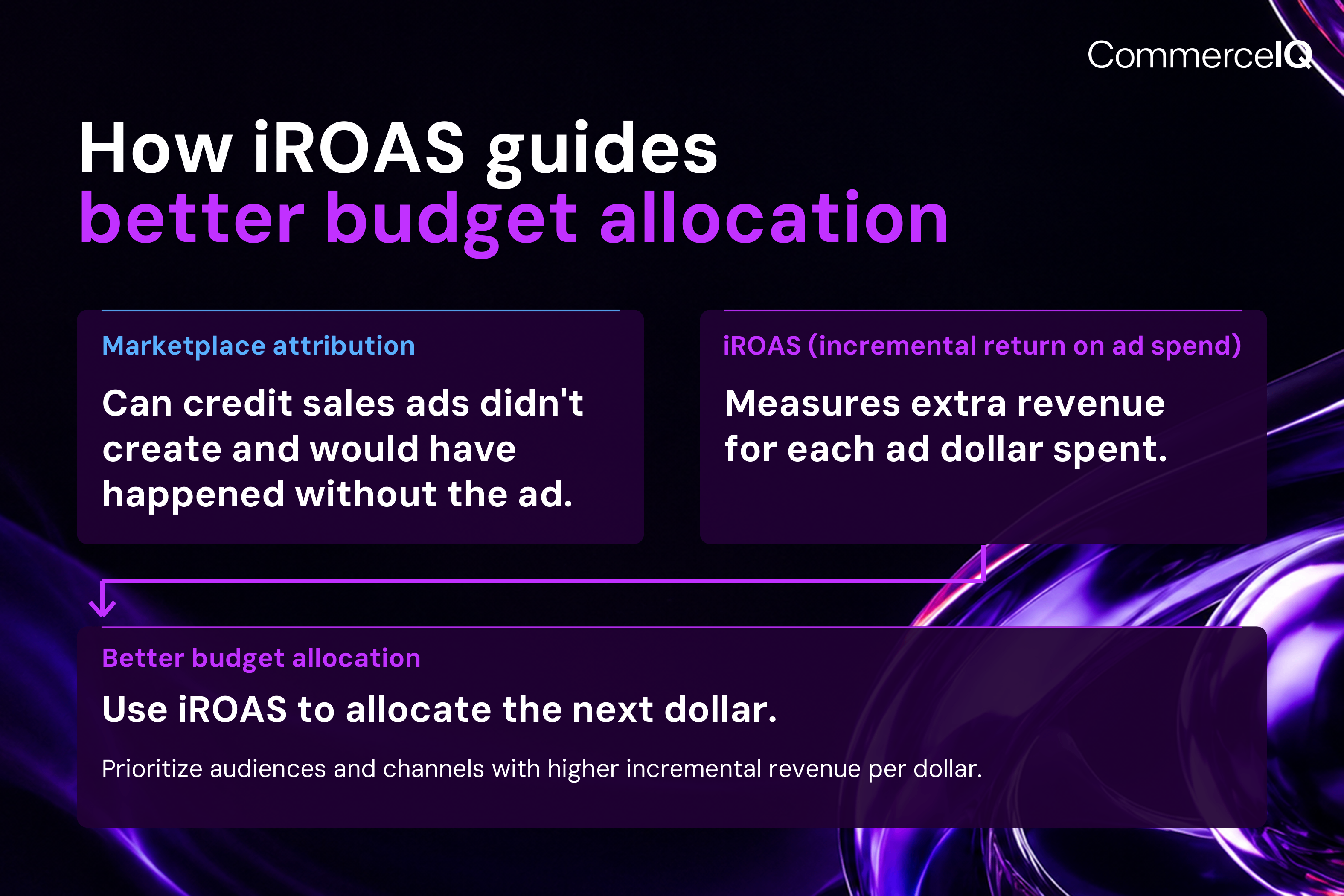
Incremental ROAS, or iROAS, estimates how much revenue came from advertising itself, rather than from demand the brand would have had anyway. For the detergent team, iROAS can reveal which segments are bringing in new shoppers and which are primarily reaching existing customers. That helps the team identify where additional investment could bring in new buyers and grow category share, rather than simply pay for sales the brand was already getting.
Reallocate the media mix toward the most cost-effective channels
One limitation of iROAS is that it tells brands how much incremental revenue a campaign generated, but not which ads shoppers saw before buying. That's where Amazon Marketing Cloud, Amazon's data clean room for advertisers, comes in, giving brands access to impression and purchase data to trace pre-purchase ad exposure and evaluate each ad's contribution.
With that level of detail, the detergent team can compare formats and audience segments based on their incremental revenue and allocate budget to the ones producing the most incremental revenue per dollar. The data still comes from Amazon, but the brand controls how it's analyzed and how the results inform budget decisions.
Brands that measure their own awareness spend can invest it with confidence
Marketplace-reported attribution gives brands a fast read on awareness campaigns while they're still live, and that speed is valuable. But when the company selling the media also reports on its results, ads can get credit for purchases shoppers were going to make anyway, and teams acting on that figure alone risk continuing to pay for customers the brand already had.
Brands that measure incrementality themselves can direct awareness budgets toward the audiences that generate new buyers. As marketplaces sell more of the media plan, from streaming video to search, an agentic retail platform like CommerceIQ brings media, shelf, and sales data together so brands can evaluate channels based on the revenue they actually create.