
Quick answer: Most brands tracking AI are asking whether they show up. The more important question is whether showing up drives sales. Retail shopping agents like Alexa for Shopping and Walmart’s Sparky are the best place to start answering it, because they sit deep in the funnel, close to the purchase. Answer agents like ChatGPT are used more for research, and the purchase usually happens later on a retailer’s site.
The question most brands aren’t asking
Right now, brands are trying to track their AI visibility everywhere. Am I showing up in ChatGPT? In Gemini? In Perplexity? Am I ahead of my competitors?
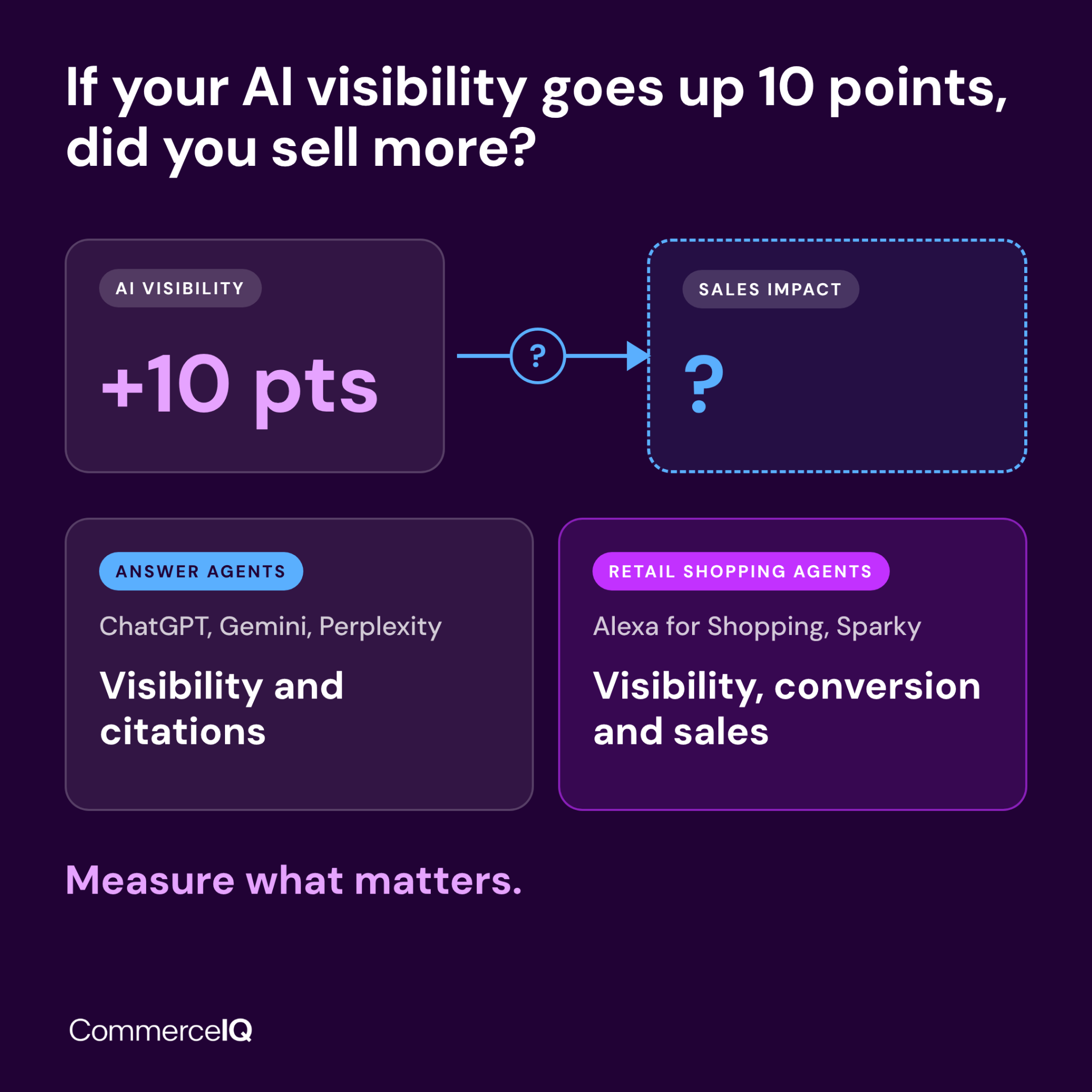
That’s a normal instinct. When something feels uncertain, you want more information. But what happens if your visibility goes up 10 points? Did you sell more? If you can’t answer that, you’ve added a dashboard without a plan for growth.
Budgets are under pressure and cost per click keeps rising, so brands need growth they can act on and measure. Connecting AI to sales starts with understanding which agents are closest to the sale.
The question changes as the shopper gets closer to buying
Think about two questions. In ChatGPT, someone might ask how to deal with grease after cooking at home. On Amazon, the same person might ask which paper towel handles grease best.
The first shopper is working through a problem. The second is already shopping, in a place where they can buy with a click.
Everyone is working toward the same end state, which is helping shoppers buy, but today these agents sit at different points in the journey.
What the numbers show
In OpenAI’s 2025 research, only about 2% of ChatGPT conversations involved purchasable products. Shopping use may well have grown since then, but people mostly use ChatGPT for a much wider range of tasks.
Retail shopping agents are built for shopping. Amazon says more than 400 million customers used Alexa for Shopping in the last 12 months, and that U.S. users spend 50% more per order than those who don’t. It has also said users of its assistant are 60% more likely to complete a purchase.
Some of that gap exists because people using a retailer’s assistant were already more ready to buy. That doesn’t prove the assistant caused all of the lift, but it does show where high purchase intent lives.
Outside research still ends at the retailer
OpenAI launched Instant Checkout in ChatGPT in 2025, then scaled it back in 2026 to focus on discovery and let merchants use their own checkout. Walmart said purchases inside ChatGPT converted at one-third the rate of shoppers who clicked through to its site.
Retailers already have the catalog, pricing, availability, logistics, and customer relationship. Answer agents often have to send the shopper to them.
Adobe found that AI-referred shoppers converted 60% better than non-AI traffic at U.S. retail sites in July 2026. That fits the same pattern: many have done their research by the time they arrive. Answer agents can shape what a shopper considers, even when last-click reporting doesn’t show it. The purchase decision still often finishes on the retailer’s site, where its agent can influence the final choice.
We’ve seen this split before
When Amazon launched retail media, many people lumped it in with Google and Meta ads. But the ad and the purchase happened in the same place, and that closed loop helped make retail media its own category, with separate systems, strategies, and agencies.
AI is starting to split the same way. Answer agents look more like Google ads. Retail shopping agents look more like retail media.
A better product page won’t always help you in ChatGPT
If you’re trying to influence a retail shopping agent, the product detail page is a critical source of truth. The agent can use the retailer’s product content and other signals to decide what’s relevant to a shopper.
Answer agents depend on what they can access, and that varies by retailer. Amazon, the largest online retailer in the US, has blocked AI agents like ChatGPT, Gemini, and Perplexity from accessing its site. Brands shouldn’t expect an Amazon page update to reach those agents directly, though they can still draw on older data and third-party pages.
Other retailers have taken a different approach. ChatGPT can read Walmart and Target product information, and some of that data reaches it through feeds, so better content there may help in both places.
Whatever the retailer, answer agents also draw on sources beyond product pages, so brands need to focus on their DTC sites, useful content, and authoritative third-party mentions.
How to connect AI to sales
- Test both. Ask the same shopper questions in Alexa or Sparky and in ChatGPT or Gemini.
- Fix the pages closest to the sale. Start with your top products, and make sure their pages answer the questions shoppers ask before buying.
- Measure each channel for its job. Use visibility and citations for answer agents. Use traffic, conversion, and sales for retail shopping agents.
- Prove the lift. Compare products you changed with matched products you didn’t. If the changed products don’t sell more, better visibility hasn’t paid off yet.
Amazon said its shopping assistant drove nearly $12 billion in incremental annualized sales in 2025. The question to take back to your team is how much of that you’re capturing.
FAQ
Is AI visibility the wrong metric?
No, but it’s an input. It shows where you appear and where you’re missing. Sales show whether that visibility matters.
What’s the difference between a retail shopping agent and an answer agent?
A retail shopping agent operates inside a retailer’s commerce ecosystem, close to the purchase. An answer agent helps people research and make decisions across many topics, and the purchase usually happens somewhere else.
Should brands ignore answer agents?
No. They can shape what shoppers consider. But if you need near-term sales you can measure, start with the agents closest to the purchase.
Does optimizing my product page help in ChatGPT, Gemini, or Perplexity?
It depends on the retailer. Don’t expect an Amazon page update to reach them directly. Walmart and Target give ChatGPT more access, so changes there may help.