For CPG brands, every dollar wasted in retail media costs more than ever before. In Q1 2026, Amazon's ad revenue grew by 24%, signifying that more brands are competing in the same auctions and paying more per click. As bidding becomes more crowded, every misaligned action retail media teams take comes at a higher cost.
Media teams are placing bids while shelf teams track inventory and PDP content, and neither side has real-time visibility into what the other sees. That disconnect is driving one of retail media's biggest problems: brands are spending more and getting less in return. They're putting spend behind out-of-stock SKUs, bidding on keywords they already rank for organically, and sending paid traffic to PDPs that aren't optimized to convert. Brands need a way to read shelf conditions and bid on that data simultaneously, in real time.
Key takeaways for retail media and digital shelf visibility
Retail media performance depends on more than bids and budgets. Brands need digital shelf visibility across inventory, organic rank, product content, pricing, and share of voice before deciding where paid spend should go.
- Retail media waste often starts when bids are disconnected from real-time digital shelf conditions.
- Out-of-stock products, weak PDP content, and already-owned organic rankings can all reduce incremental ROAS.
- Agentic retail connects shelf signals to bidding decisions so spend shifts toward SKUs and keywords with the strongest conversion opportunity.
What happens when retail media bids ignore the digital shelf
The media team and the shelf team typically operate in silos. Most retail media platforms only show the bidding side of the equation, limiting these teams' visibility to bids, budgets, and ROAS. They can see what to bid on, but not whether the product is in stock, how strong the PDP content is, or whether the product already ranks organically.
Even when teams have access to shelf data, it's often housed in a separate system, requiring manual bid adjustments across marketplaces and catalogs with thousands of SKUs. By the time teams identify an issue and decide how to respond, the shelf conditions have already shifted.
The most immediate consequence of an inefficient system is wasted spend on out-of-stock SKUs, where shoppers who click the ad land on a page that says "currently unavailable," leading customers to exit or worse, go straight to a competitor with a similar product that is in stock.
But the potentially higher cost comes from bidding on keywords the brand already owns in organic search. In those cases, the ROAS may look strong, but the ad spend isn't driving incremental sales; it's taking credit for conversions that would have happened anyway through organic search.
How digital shelf visibility improves retail media bidding
When brands can synchronize shelf signals with bidding decisions, ad spend becomes more efficient. Using agentic retail, brands can connect real-time shelf conditions to their media execution, shifting budget toward SKUs that are in stock, keywords where organic visibility hasn't yet been earned, and PDPs positioned for conversion.
Spend shifts toward incremental opportunities
In practice, AI agents continuously evaluate shelf signals such as inventory levels, PDP content quality, competitor pricing, and search position, recalibrating bids and budgets as soon as any of these change. Of those signals, organic search ranking carries the single biggest impact.
When a product ranks organically in the Top 5 for a keyword, the agent typically pulls bids back on that term and reallocates spend to keywords the brand hasn't yet earned visibility for. The product is already capturing meaningful traffic, so continuing to bid aggressively would only yield diminishing returns.
This is where incrementality becomes key. Incrementality is the metric that separates ad-driven sales from sales that would likely have happened anyway. When brands optimize for incrementality, they shift ad spend toward highly relevant keywords where paid media is more likely to generate net-new demand rather than simply take credit for existing organic performance.
Incremental ROAS (iROAS) quantifies how much revenue is attributable to advertising rather than to existing demand.
iROAS = incremental fraction × ROAS
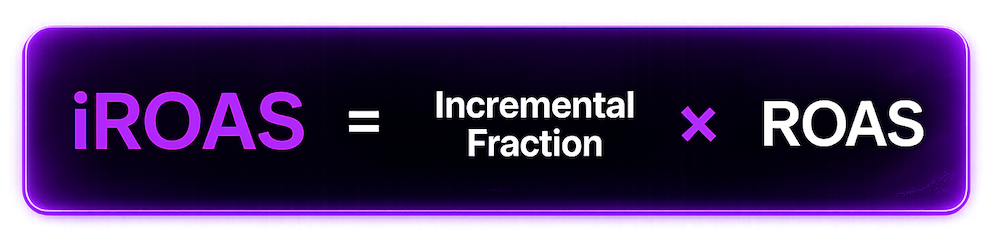
An agentic retail platform like CommerceIQ computes the incremental fraction daily at the search-term level using a neural network trained on more than 50 sales and shelf signals. This enables real-time, keyword-level optimization across 100 retailers, unlike traditional category-level marketing mix models that cover only one or two retailers and rely on data that can lag by weeks.
Brands defend their share of voice
Once ad spend is aligned with shelf conditions and optimized for incremental lift, brands can shift their focus toward defending share of voice.
With agentic retail, brands can set a target share of voice at the category level, and agents will continuously adjust bids across thousands of keywords and SKUs to help maintain it. A single strategic input from the team becomes ongoing execution across the entire catalog, with bids rising or falling based on what the competition is doing, where listings rank organically, and the strength of inventory.
Bidding without shelf signals can cost brands more than they realize
Digital shelf visibility gives retail media teams the context they need to avoid waste, improve incrementality, and keep spend aligned with the SKUs most likely to convert.
Retail media and digital shelf visibility FAQs
What is retail media optimization?
Retail media optimization connects bid decisions to real-time shelf signals such as availability, organic rank, content quality, pricing, and competitor movement.
Why does digital shelf visibility matter for retail media?
Digital shelf visibility matters because paid traffic only performs when the product page can convert. If a SKU is out of stock, poorly ranked, or missing key content, additional media spend can amplify the problem instead of solving it.
Which shelf signals should brands use before increasing spend?
Brands should look at inventory status, search rank, PDP content health, competitor pricing, share of voice, and incremental ROAS before increasing spend.
Retail media budgets go further when bids reflect real-time shelf conditions. The Q2 2026 State of Ecommerce Report shows why media efficiency, margin pressure, and availability need to be managed together. When shelf signals and media execution work together, every dollar drives more incremental sales. As marketplaces become more crowded and CPCs continue to climb, CommerceIQ provides CPG brands with an agentic retail platform that closes the gap between shelf signals and media decisions in a single, connected workflow.