
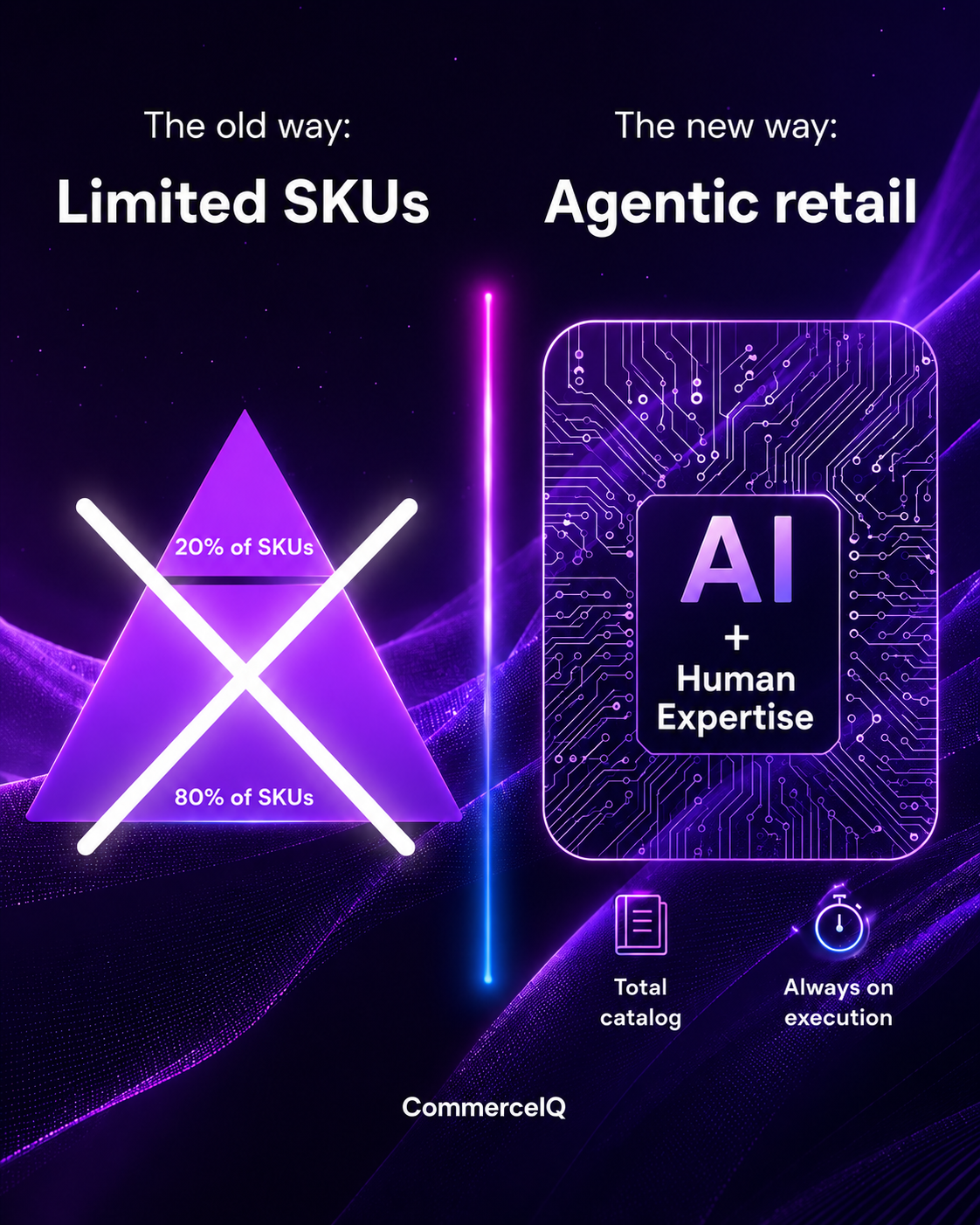
Focus on the 20% of products that drive most of the revenue — that's been the strategy CPG brands have stood behind for decades. But the problem with the 80/20 rule is that it leaves 80% of your SKUs to receive minimal content updates, limited ad support, and almost no oversight across marketplaces.
That tradeoff used to work when managing a full catalog across marketplaces wasn't possible. At some point, it doesn’t make sense to add headcount to a SKU or group of SKUs because the revenue per SKU doesn’t support it. No matter how many agency hours were added or how many manual workflow improvements were made, there was a cap on the number of SKUs a brand could handle. This is why allocating resources to top performers that justified the cost through high-volume sales made sense.
No amount of data or new reporting tools could help solve this execution problem, either. In fact, 40% of commerce teams say they have too much data to process, and 42% say they don’t have enough time to make decisions on that data. Expanding capacity or adding more dashboards doesn't fix the problem because the bottleneck is the model itself, not the headcount or the insights.
Agentic retail is the emerging approach brands are using to remove these bottlenecks by deploying AI agents to handle execution across every SKU, making full-catalog management feasible for the first time.
What the 80/20 rule costs CPG brands
The traditional agency model that enforces the 80/20 rule is costing more than it returns on the 20% it covers. In fact, 55% of CPG leaders say agency costs are too high relative to results, and 40% cite response times that can't keep pace with algorithms. This is because marketplaces now update in real time, but agency workflows still operate on weekly review cycles. That creates an opportunity for top SKUs to lose Buy Box positions, drop in search rankings, and miss competitors' price changes.
The brand is paying for active management but receiving only reactive updates. A traditional agency can only run so many optimizations on an average day, so a brand with tens of thousands of SKUs will never optimize its entire catalog. Every week that passes with an unoptimized catalog means product pages stop meeting marketplace requirements, ad budgets keep going to SKUs that aren’t converting, and search rankings drop on products that should be earning visibility.
A single underperforming SKU doesn’t do much damage on its own, but multiply that by hundreds or thousands of SKUs, and brands are handing their competitors exactly what they need to take Buy Box positions, search visibility, and the repeat purchases that follow.
How agentic retail makes full-catalog management possible
Agentic retail removes the speed and capacity limits that made the 80/20 rule necessary. A content agent can update a product page in 35 seconds, while that same task can take a human 35 minutes. That means an agent can run thousands of optimizations a day.
With execution at that scale, search visibility improves across the entire SKU catalog; lost Buy Box positions are flagged and corrected in real time; and media spend is reallocated accordingly. Every product in the catalog gets the attention once reserved for the bestsellers.
Agentic retail needs to run on a unified data model — shelf, inventory, media, and sales living in one system— so agents across functions share the same intelligence. When the media agent adjusts spend on a product, it already knows whether the product is in stock, how its content is performing, and where it ranks in search results. Every decision made in one part of the catalog takes into account what's happening elsewhere. That coordination is what an agency model can't replicate, no matter how many tools it adds.
The economics of the 80/20 rule invert under that model. With traditional agencies, every additional SKU brought into active management costs more — more hours, a higher retainer, and more capacity. With agentic retail, every SKU that moves from unmanaged to actively optimized is a product that was either underperforming or entirely invisible to shopping agents. Even small improvements per SKU — a recovered Buy Box position, an updated product description for AEO, a reallocation of ad spend toward a listing actually converting — can compound, creating revenue that wasn't being captured before.
Brands already adopting agentic retail are seeing performance improvements ranging from 10x to more than 100x in task speed, optimization volume, and operational scale compared to competitors still operating under the 80/20 model.
The 80/20 rule is no longer a constraint. It’s a choice
A decade ago, leaving the other 80% of the catalog unmanaged was tolerable because the top performers carried the business. Today, that 80% is where competitors are winning market share.
CPG teams in 2026 can't afford to accept reactive management of hero SKUs and no management for most, because their competitors are using agentic retail to optimize across their full catalogs.
Learn how CommerceIQ can help your brand move beyond the 80/20 rule and actively manage all SKUs across every marketplace.