
One of the questions I get most often from brand leaders, especially as we head into the summer, is some version of: "What should our retail media strategy look like around Prime Day?"
It's a fair question. Prime Day is one of the most consequential selling events on the calendar for most CPG brands, and the stakes are genuinely high. Get it wrong and you've blown a meaningful chunk of your annual media budget in 96 hours. Get it right and you've hit your sales targets, moved inventory, and built brand awareness that pays dividends for months.
But here's the thing: when I dig into how most brands actually approach Prime Day, they're treating it as a point-in-time event rather than a strategic window. They ramp spend on Day 1 and ramp it back down on Day 4. That's leaving significant performance on the table before and after the event.
So let me share what the data actually shows, and the framework my team recommends for structuring your media investment across the full Prime Day arc.
The Uncomfortable truth about Prime Day efficiency
First, let's acknowledge the paradox that every retail media practitioner knows but few say plainly: Prime Day is an expensive time to advertise.
We analyzed Amazon Marketing Cloud time-of-day data from last year. During Prime Day 2025, brands collectively drove a 2.56x lift over a typical week. But ad spend grew even faster, jumping 3.3x. The result: ROAS dropped 18%, from 10.5x in a normal week to 8.65x during Prime Day.
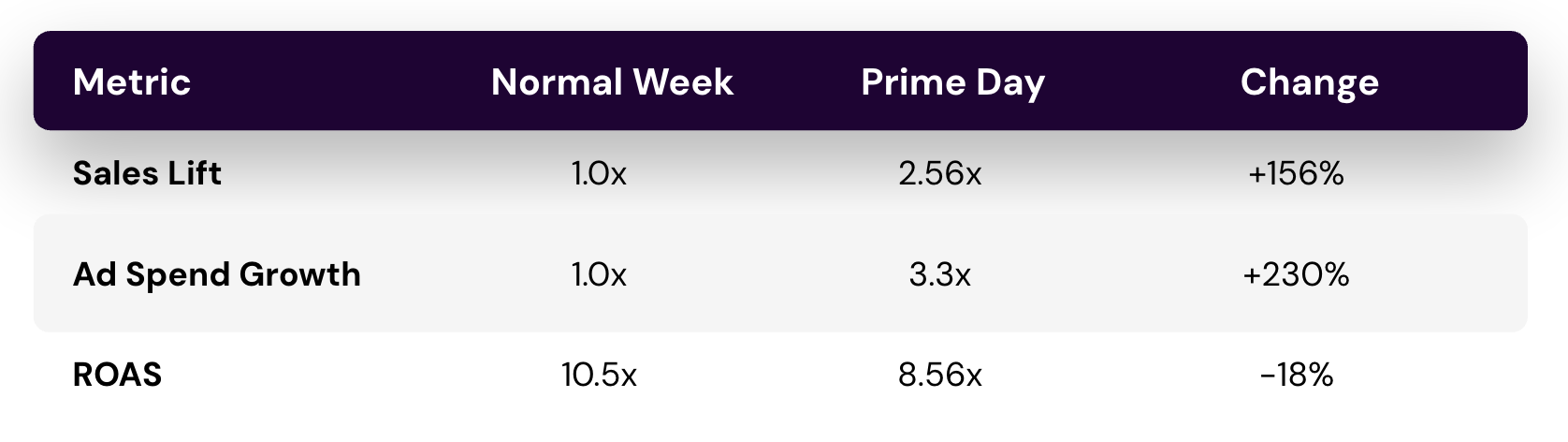
This is not a failure. It's the nature of the moment. When every advertiser on Amazon cranks up bids simultaneously, CPCs inflate and auction efficiency compresses. You're not doing anything wrong. You're competing in a zero-sum auction that's suddenly a lot more crowded.
The strategic question, then, isn't whether to participate. You have to. It's how to structure your investment so you're buying the right moments rather than just the loudest ones. And crucially, it's how to frame the week before and the week after as equal parts of the strategy.
Pre-Prime: Build the foundation while it's still cheap (T-minus 4 days)
The week before Prime Day is one of the most overlooked windows in retail media. Shopper intent is building. Consumers are browsing deal lists, adding items to wishlists, making shortlists. CPCs, however, are still at normal levels. Your competitors are likely still on the sideline.
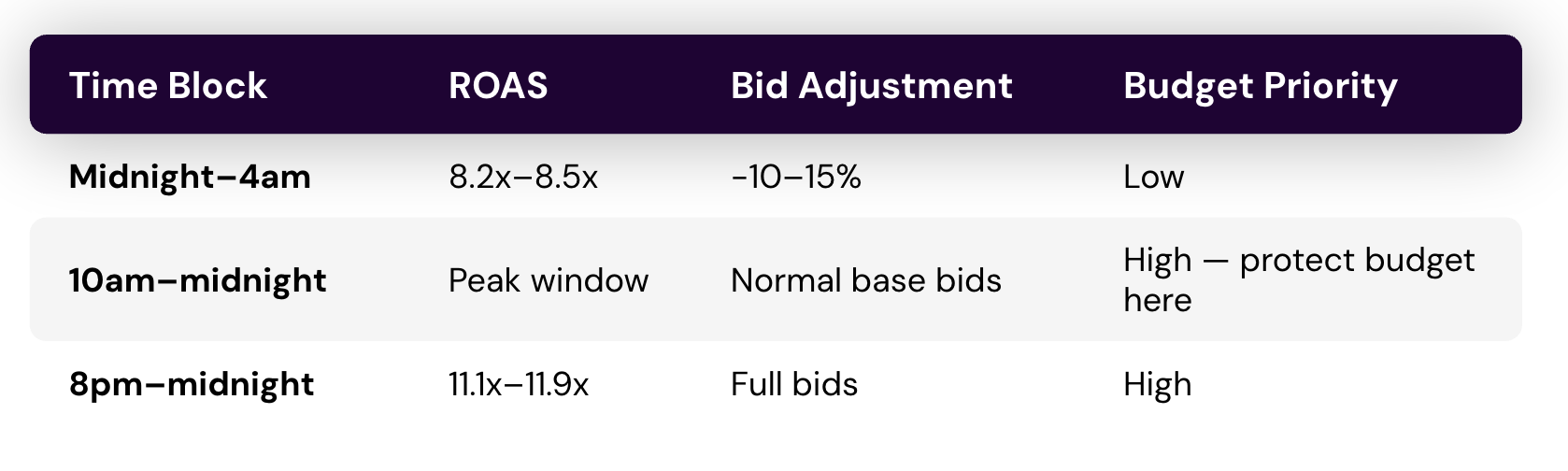
My recommendation for this window: run at your standard daily budget with normal base bids, but structure your dayparting to prioritize the high-efficiency hours. Our data shows that on a normal week, ROAS peaks in the afternoon and evening — the 8pm–midnight window hits 11.1x–11.9x. Early morning (midnight–4am) underperforms significantly at 8.2x–8.5x. Apply 10–15% bid reductions overnight and protect budget for the 10am–midnight window.
This period is also when operational readiness matters as much as media strategy. Lock in your promotional pricing. Confirm inventory positions on your top ASINs. Ensure your deal submissions are in. Nothing destroys Prime Day performance faster than winning the impression and losing the sale because you're out of stock or your deal didn't go live.
The mindset I'd encourage here: pre-Prime is preparation, not performance. You're not trying to win impressions, you're setting up conditions to win.
Prime Day: Spend more, but know exactly when
When the event goes live, you need to behave differently than you do the other 361 days of the year. Our recommendation: raise your base bids to 1.35x your normal level and set your daily budget cap at 2.5x your typical daily spend.
That sounds aggressive. But given that overall sales lift is 2.56x, it's proportionate. You're matching your media investment to the size of the addressable market, not overspending relative to it.
The more nuanced question is how to distribute that budget across the clock. And this is where our AMC analysis reveals something most brands are missing.
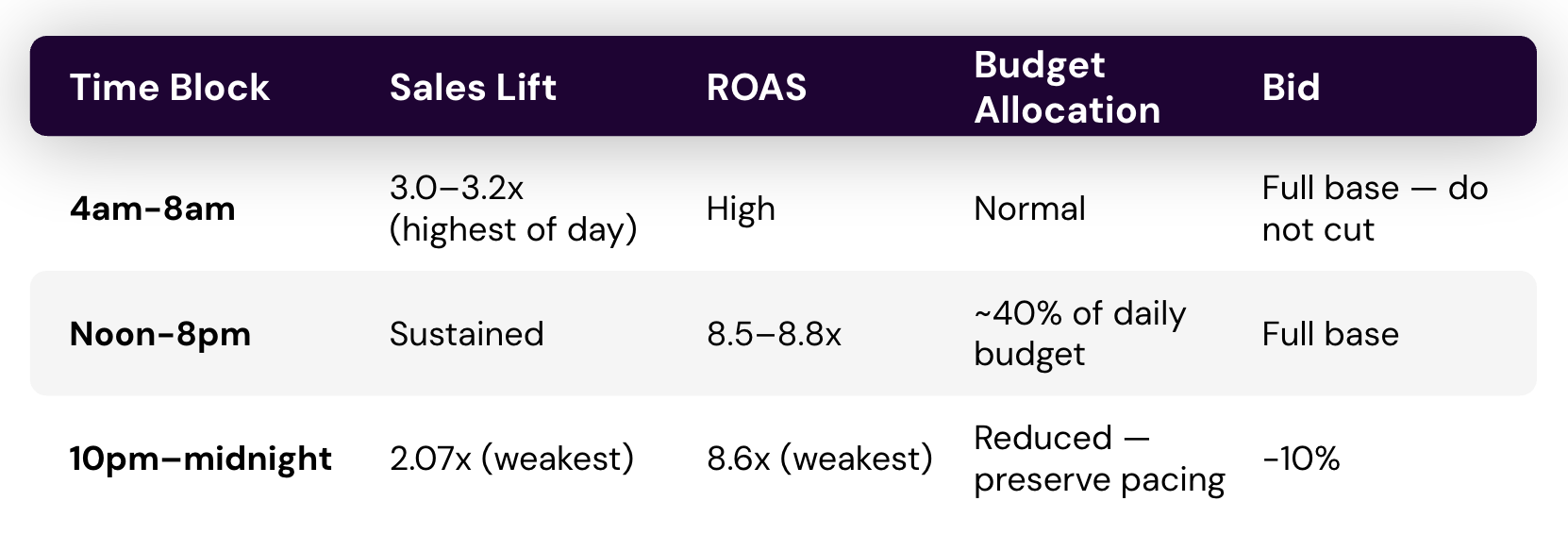
The early morning opportunity. Between 4am and 8am ET, Prime Day generates a 3.0–3.2x sales lift over a normal week, which is the highest lift of any block in the entire day. These are deal hunters who specifically set their alarms for Prime Day. They're high-intent, and they're largely uncontested because most advertisers are still running overnight minimums at this hour. My recommendation: run full base bids from 4am–8am. Don't cut here.
The afternoon engine. From noon to 8pm ET, Prime Day sales volume is sustained and massive with ROAS holding around 8.5–8.8x. Allocate roughly 40% of your daily budget to this window and hold bids at or near base. The campaigns that fail here are the ones that exhaust the budget in the first half of the day and go dark right as the afternoon surge begins.
Where to pull back. The 10pm–midnight window is the one place where a bid reduction (around 10%) makes sense. Both sales lift (2.07x) and ROAS (8.6x) are the weakest of the day. The goal isn't to save money; it's to preserve pacing room for the next morning's early-bird block.
One thing I want to be direct about: your ROAS will look worse during Prime Day than it does in a normal week, and that's normal. Brands that panic and pull back spend because the numbers look "bad" are the ones surrendering shelf space, organic rank, and brand awareness to competitors who stayed the course.
Post-Prime: The efficiency window to take advantage of
Here is the insight I find myself repeating most often, and the one that tends to get the most surprised reactions: the week after Prime Day is frequently more efficient than Prime Day itself.
In our data, the seven days following Prime Day show ROAS recovering sharply as competitors retreat to normal spend levels. The late-night window (10pm–midnight) hits 14.8x ROAS post-Prime — the highest ROAS of any block across all three periods, and nearly double the Prime Day average.

Why? Residual intent. Consumers who deliberated during the event but didn't convert are still in buy mode. They're making purchases they considered but held off on. And they're doing it in a dramatically quieter advertising environment, where CPCs have returned to normal but shopper intent hasn't fully faded.
For this period, I recommend: set base bids at 1.05x normal and daily budget at 1.1x normal. Run the full day, but protect the evening and overnight hours; especially 8pm–midnight, which runs 13.1x–14.8x ROAS post-Prime. Apply 15–20% bid reductions to early overnight only (2am–8am), where ROAS is softer. This is precision, not retreat.
The mindset: post-Prime is the efficiency harvest. You've already paid for the awareness and consideration that Prime Day generated. Now you're converting residual intent at a fraction of the cost.
The Framework at a glance
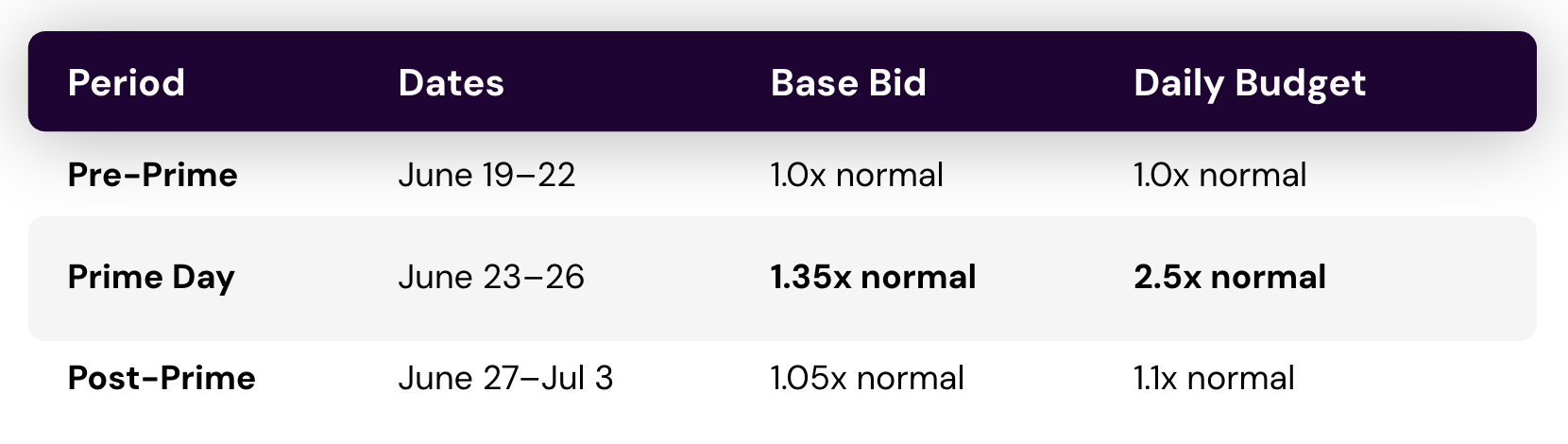
This is a 15-day media strategy, not a 4-day one. The brands that treat it that way will have meaningfully better results to show in their Q3 business reviews.
How AllyAI for Media makes this actionable
I want to be honest about something: the strategy I've described above — 8 distinct bid blocks per period, per-period base bid adjustments, budget pacing that protects early morning and afternoon windows simultaneously — is not something you can easily execute manually or through standard Amazon campaign controls. It requires precision that native tooling simply doesn't offer.
This is exactly what we built Ally for Media to solve.
Ally for Media is CommerceIQ's intelligent retail media platform, and one of its core capabilities is advanced dayparting. Ally analyzes your AMC time-of-day data and automatically identifies the optimal bid levels for each moment of the day — adjusting dynamically across Pre-Prime, Prime Day, and Post-Prime periods without requiring manual intervention from your team. The Prime Day strategy in this post was generated directly from Ally's Dynamic Daypart Agent, trained on data from CommerceIQ clients.
More broadly, Ally brings the same intelligence to every dimension of your retail media program: budget allocation, keyword strategy, share of voice, and competitive response. For events like Prime Day, where the stakes are high, the windows are narrow, and the data changes by the hour. Having a platform that can act on signals in real time isn't a nice-to-have. It's the difference between a strategy on a slide and a strategy in the market.
If you're heading into Prime Day and want to talk through how Ally can support your program, I'd love the conversation.