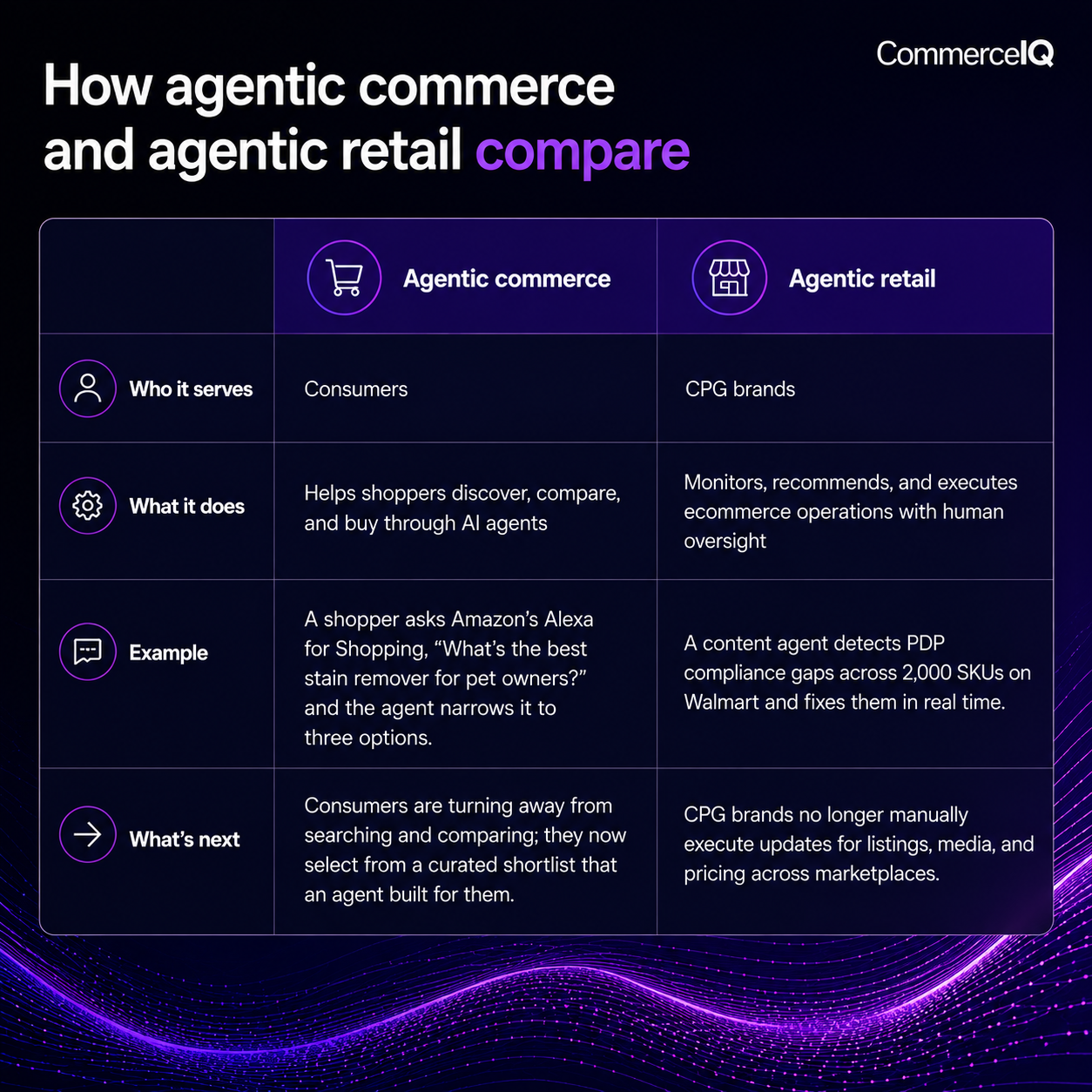
Agentic commerce has become a ubiquitous catch-all phrase popping up in headlines and tossed around at conferences to describe any agent application in retail. But agentic commerce should refer only to how shoppers leverage AI, specifically agents like ChatGPT, Amazon's Alexa for Shopping, and Walmart's Sparky, to make purchases.
Retailers are using AI agents in a fundamentally different way than shoppers. Through agentic retail, brands are training agents to monitor, recommend, and execute ecommerce operations across the digital shelf, retail media, pricing, inventory, and content, with built-in human oversight.
The difference between agentic commerce and agentic retail is less about vocabulary and more about knowing who is using the agent and what they're asking it to do. Brands that understand how their customers use AI to shop are better equipped to respond by investing in the tools that help them manage their retail operations and keep pace with agentic commerce.
How shoppers are using agentic commerce to buy
Customers used to scroll through product options and compare prices, reviews, and product descriptions. Now, they're handing off product discovery, comparison, and, in some cases, checkout to AI agents like Alexa for Shopping and Sparky, as well as third-party tools like ChatGPT, and asking them to curate a shortlist. According to Deloitte, by 2030, 25% of global ecommerce sales will be enabled by these AI agents. This changes which products customers see and which never reach them.
For example, a shopper might ask ChatGPT for a “non-toxic dish soap under $10 with a rating of 4 stars and above.” The agent returns three options that it chose based on ingredient lists, reviews, and price. Brands that don't match this criteria, even those the shopper would have considered while scrolling, never make it to the list.
This behavior is already widespread. By October 2024, Amazon's Alexa for Shopping (formerly Rufus) was handling around 274 million daily queries, accounting for about 13.7% of all Amazon searches. Last year, more than 300 million shoppers used the AI shopping assistant, and those shoppers were 60% more likely to complete a purchase.
The first visitor to a brand's product pages is no longer the shopper — it's an agent scanning titles, analyzing descriptions, checking reviews, and deciding which products match the shopper's request. Brands writing pages only for human eyes are losing visibility, with the agents becoming gatekeepers to what shoppers see. To make the shortlist, brands need to optimize for agents by using agents.
How CPG brands are using agentic retail to sell
Brands manually optimizing their listings aren't keeping up with the speed of updates surfaced by AI. Agents update their recommendations in real time, while agency cycles and reviews take place over days and weeks. By the time a team rewrites a product page, a competitor's listing is already on the shortlist. And if a product display page isn't written with the context AI agents are looking for, the listing stays invisible, no matter how quickly it's updated.
With agentic retail, AI agents run 24/7, acting on search-ranking drops, Buy Box losses, and content gaps as they happen. An agent identifies the issue, generates a recommendation, and explains the reasoning. A team member reviews and approves (or declines) the change, and it gets published to the marketplace. As the team member builds trust with the agent, they can decide to fully automate the process.
Agentic retail can handle every part of ecommerce execution because each agent specializes in a different piece of the puzzle. A content agent identifies PDP gaps, generates fixes, and publishes the change to the marketplace once a team approves it. Agents across media, sales, and shelf also perform monitor-recommend-execute work within their own domains.
Together, these agents handle the full operational work of running ecommerce at a speed manual workflows can't match. Adam Colasanto walked through how that model applies across discovery, consideration, conversion, and delivery in his CommerceNext talk on AI across the ecommerce funnel. For example, Newell Brands worked with CommerceIQ to build a customized content agent in under 80 days and saw a 40x improvement in time saved on PDP optimization. Instead of managing only the top-performing SKUs, the company can now continuously manage the full catalog.
Why agentic retail is the answer to agentic commerce
The way consumers buy and the way brands sell are changing, and the retailers that understand both sides — the tools their customers use and the tools available to them — will have the clearest picture of where ecommerce is heading.
As retail moves into a fully algorithmic future, one that outpaces what human teams can handle on their own, CPG brands need an agentic retail solution like CommerceIQ to stay competitive across every marketplace they sell on.