
Amazon moved Alexa for Shopping into the main search bar in May, making an AI shopping agent the default first stop for product discovery on Amazon. Shoppers who use it are already 60% more likely to complete a purchase, according to Amazon, so the products it recommends account for an outsized share of sales.
Brands are shifting their strategies as a result, since Alexa for Shopping doesn't make recommendations based on the same criteria that brands used to target to win share of search. Shopping agents consider more than whether keywords in a product title match the shopper's search; they're analyzing entire listings, from the descriptions and reviews to the attributes and pricing, before recommending a shortlist of matches.
A brand with a high share of search can still get left off that shortlist if the listing hasn't been optimized for answer engine optimization (AEO), and the shopper who's no longer scrolling through search results could never see the product. To be recommended, brands need every listing structured and kept current as the agent's evaluation criteria evolve.
Brands now sell through an AI shopping agent that knows every shopper
Alexa for Shopping recommends different shortlists to every shopper, interpreting the intent behind each request and factoring in what it already knows about the shopper from past purchases. This means two shoppers who type nearly the same words in the search bar can receive different recommendations; the agent may point a price-conscious shopper to a value brand and an all-organic buyer to a premium label.
Because the agent matches products to each shopper, brands can no longer improve their share of search and expect that visibility to put them in front of everyone. The agent instead responds with a few recommendations. The shoppers receiving those shortlists are closer to buying because they described a specific need, and the agent surfaced only the products that match it. Therefore, a brand's listing has to answer the exact request the agent is filling, across every product it sells, not just the bestsellers.
How to optimize for Alexa for Shopping
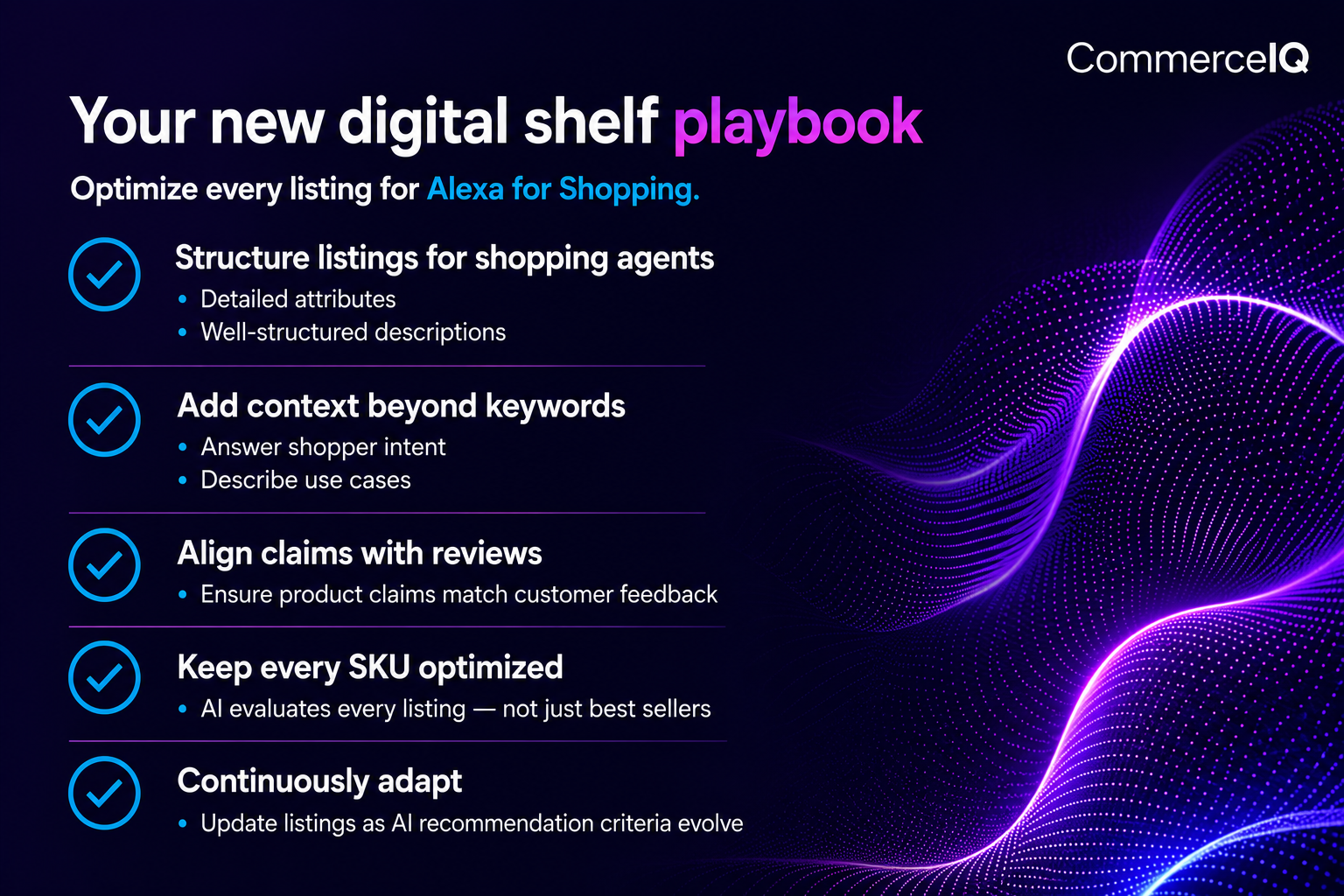
To win agent recommendations, brands have to optimize each listing for how Alexa for Shopping parses its structure and verifies product claims. Each page needs enough accurate detail for the agent to match the product to the shopper's request and what it already knows about them.
Prioritize structure over content
No matter how well-written the copy is, if the listing is missing attributes or the text is too dense, the shopping agent won't be able to find the information it needs, and therefore, the product won't be included on its shortlist.
Alexa for Shopping parses a page in its entirety before making a recommendation, so brands should share complete structured attributes and break the description into single-idea bullet points so the agent can determine what the product is or who it's for.
Rewrite the title to identify the product, not just rank
The title is the agent's primary handle on what the product actually is. A title built around brand and model number gives it almost nothing to match against; one that names the product type, the key differentiator, and the primary use case gives it three things to work with. Lead with plain-language identification and let keyword coverage follow from that, rather than the other way around. A title assembled from high-volume search phrases can read as relevant to a keyword and still leave the agent unable to say what the product is.
Add context that answers every intent
The shopping agent is seeking context beyond the product title to surface the listing that best matches a shopper's search. The shopper may ask Alexa for Shopping to find "a detergent for sensitive skin, compatible with my Whirlpool Washer, that can last over a month." The agent interprets this request by searching for a detergent that's scent-free, safe for an HE (high-efficiency) washer, and that has enough units to last more than 30 loads.
Context on the page needs to answer the agent's longer, more specific query, not the shopper's. A keyword-loaded title built to mirror the phrases customers are likely to type into the search bar no longer works.
Give the description room to state every constraint
The description is where constraints that don't fit a structured field get established: compatibility ranges, what's included, how long a pack lasts, the conditions a product is and isn't suited to. A short description reads cleanly and leaves the agent with little to verify. Use the space to cover secondary use cases and edge conditions explicitly, in plain sentences rather than marketing phrasing, and state the specifics even where they feel obvious to someone who already knows the category.
Match every claim to the reviews
The agent compares what the brand claims a product can do with what shoppers report in reviews, not just the star rating. Because it repeats those claims in its recommendation and avoids any with contradictory reviews, a listing with claims that match what shoppers report is the safer one to recommend.
Mine shopper questions for the constraints you're missing
The questions and reviews already on your listing are a free record of what shoppers need to know before buying, and every recurring question is a constraint the agent may be asked to verify. Read them as research rather than as customer service: when the same question keeps appearing, that's a signal the answer isn't established anywhere the agent can find it. Then put each recurring answer into the attributes and description, where it will actually be read.
Brands optimizing for Alexa for Shopping are taking share
Product discovery on Amazon now starts with an agent, not a search bar. Brands that update every listing to answer what shoppers ask stay in Alexa for Shopping's recommendations and take sales from competitors who still optimize for a high share of search. For one large-assortment CPG brand where seasonality drives the product mix, our data showed that optimizing listings for search and the shopping agent, while continuously updating them to reflect changing shopper intent, increased sales by 9% after controlling for stock availability and media spend.
As Alexa for Shopping learns more about each shopper, brands need an agentic retail platform like CommerceIQ to help keep every listing across the catalog optimized as the shopping agent's recommendation criteria continues to evolve.